
When an RFP says ASTM F3561
ASTM F3561 rates complete window and door systems, not film on existing glass. What it means, what to specify instead, and what Epic hands a buyer.
5 min read · Updated October 21, 2026
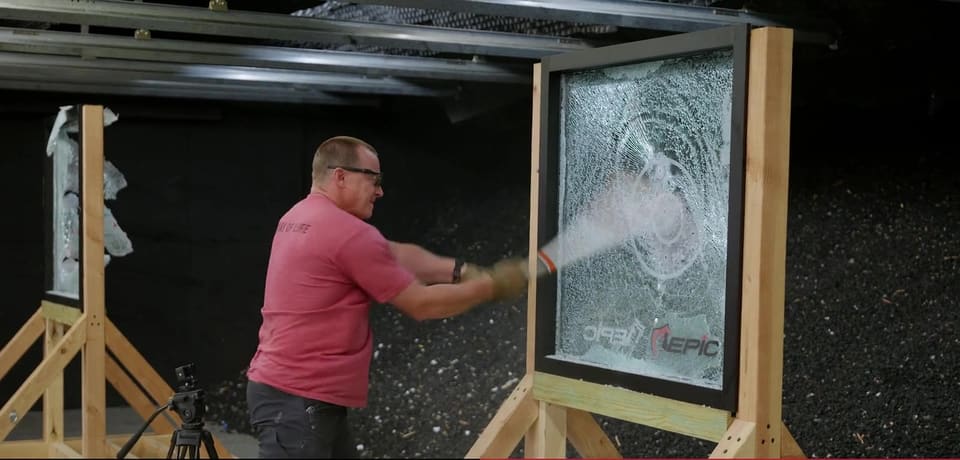
The line usually arrives in a template. A district or an agency writes a security film RFP, borrows the glazing section from a new-construction spec or a window manufacturer’s submittal, and somewhere in it is a sentence like “products shall be tested to ASTM F3561.” The glass is not being replaced; the film is going on what is already there. Every bidder now has to answer a requirement written for a different product. Here is what the sentence means, why it does not fit, and what to do before the bids come in.
What the standard actually tests
ASTM F3561 is the Standard Test Method for Forced-Entry-Resistance of Fenestration Systems After Simulated Active Shooter Attack. ASTM International’s Committee F12 on Security Systems and Equipment approved it in August 2022; the current edition is F3561-25. It is a laboratory test for complete, factory-built window, door and modular panel systems. The specimen is weakened with ten rifle rounds in a fixed pattern, then struck by a 100-pound pendulum at rising energies until a six-inch sphere can pass through, and the whole system, glass, frame, anchors and hardware together, earns a forced-entry resistance rating from Level 1 to Level 8. The standard’s own scope calls it “a laboratory test to be performed on full systems.”
That phrase is the one that matters for retrofit. The International Window Film Association puts it plainly: “Neither installed window film nor retrofit glazing incorporated into existing framing or doors is covered.” 3M’s technical bulletin on the standard says the test method “was not designed to evaluate retrofit building window film” and tells its dealers not to use it in the promotion, marketing or specification of its films. Epic is a 3M Platinum Elite National Dealer and agrees with both. You will not find “F3561 compliant” on anything Epic puts in front of a buyer; if a submittal says it, the right question is what, exactly, was tested.
Why Epic tested to it anyway
A good objection does not win a bid, and “it doesn’t apply to us” is not an answer a purchasing officer can act on. So in August 2026 Epic had its installed system, 3M S2400 attached to standard commercial aluminum storefront framing with 3M Impact Protection Attachment installed the Epic way, tested to the standard by Intertek Building & Construction in York, Pennsylvania, an ISO/IEC 17025-accredited laboratory. Four assemblies, two sizes in duplicate, reached Level 2, and the smaller and larger specimens performed the same.
Epic reports that as exactly what it is: the tested result for those four assemblies, under that method, on that date. It is not a product rating, not a claim that any film “meets” or is “certified to” ASTM F3561, and not a comparison between films. Only insulated glass was tested; results do not transfer to monolithic glass. The standard itself says that anything short of a complete system earns a capability statement, not a system rating, and that is how Epic reads its own result. What the data is good for is narrower and more useful: a specifier who is required to ask about F3561 can see what an attached-film assembly did under the standard’s own procedure, from an independent lab, with the film, attachment, glass and framing named. The position statement that carries the report summary is called The Retrofit Gap; it is the download on the F3561 explainer.
What to write instead
If the project is film on existing glass, keep F3561 out of the film section and write it on the standards that evaluate film and attached film. UL 972, burglary-resisting glazing material, for break-and-entry resistance. ANSI Z97.1 and CPSC 16 CFR 1201 for safety glazing. ASTM F1642 with GSA TS01-2003 for blast mitigation where it is in scope, which 3M applies to commercial and non-educational government facilities. ASTM E1886 and E1996 for windstorm debris impact. The film manufacturer’s four-sided attachment requirement. And a laboratory report on the installed assembly, film, attachment and framing together, rather than on film alone. Epic’s free guide specification is written on those standards, with a specifier note that reads, in part, “Do not write this Section as ‘F3561 compliant.’”
Then ask every bidder for the same thing: the lab, the report number, the exact film and attachment tested, the framing, and how that matches the openings being quoted.
The question underneath the requirement
Before any of that, ask what is being bought. If the answer is a new or replacement window and door system, that is a fenestration manufacturer’s product, a complete window or door tested as a unit, and Epic will say so rather than bend film to fit the sentence. It usually belongs on a few openings, not the whole building. If the answer is protection for glass that is staying, attached security film is what fits, and the entries and vestibules an intruder reaches first get the thickest film 3M makes, anchored to the frame.
The standard’s name has “active shooter” in it, and that pulls buyers toward the heaviest product on the shelf for every opening. Glazing built to stop bullets does not stop being a wall when the emergency changes; in a tornado, a fire or a collapse, or with an intruder already inside, the people in the room and the first responders outside may need to get through the glass. Security film is designed to resist entry from the outside; it does not seal people in. The right scope protects the people behind the glass on every opening and still lets them leave.
What Epic hands you
Send the spec or RFP section to sales@epiccos.com, or call 866.EPIC.117 (866.374.2117). An Epic Solutions Advisor returns the written response package: The Retrofit Gap with the Intertek test summary, 3M’s published test data for the film specified, the Epic Method spec sheet, and district and agency references you can call. Epic is SAM.gov registered, 100% woman-owned, and purchasable through TIPS and Equalis nationwide and BuyBoard in Texas, so the response can be a contract rather than a bid cycle. The full explainer, with the levels table and the sources: ASTM F3561 and retrofit security film.
Questions people ask
Does ASTM F3561 apply to window film?
What should a security film RFP specify instead of ASTM F3561?
Has Epic tested its security film system to ASTM F3561?
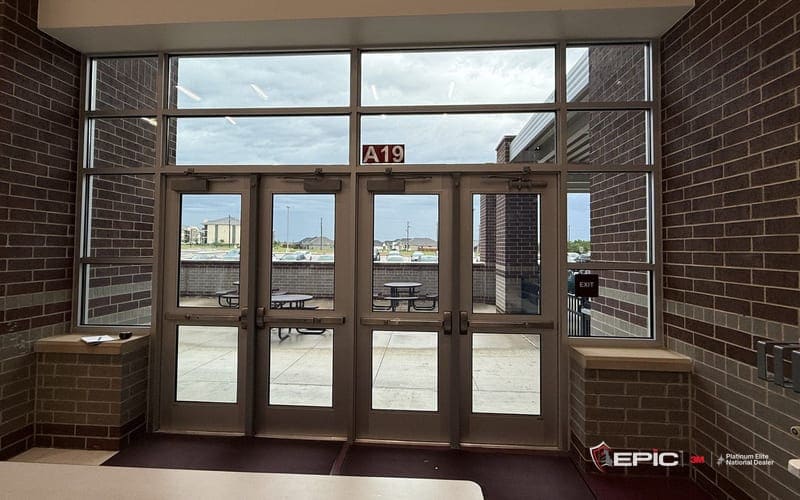
See 3M security film on school doors before it goes on.
Not sure what a visualizer is? It’s a picture of sample school entry doors. Pick a 3M safety and security film, drag the handle to compare the glass with and without it, and read 3M’s published light and heat numbers beside the picture. Or upload a photo of your own doors; it stays on your device.
- 1Pick a room
- 2Pick a 3M film
- 3Drag to compare
Ready for a firm number on your glass?
A free on-site assessment. Measurements, film recommendation, and a written estimate — no pressure, no obligation.
 Cookies on epiccos.com
Follow the work
Real installs, real tests, real schools. Pick the feed you actually open — same crew, same standard everywhere.