
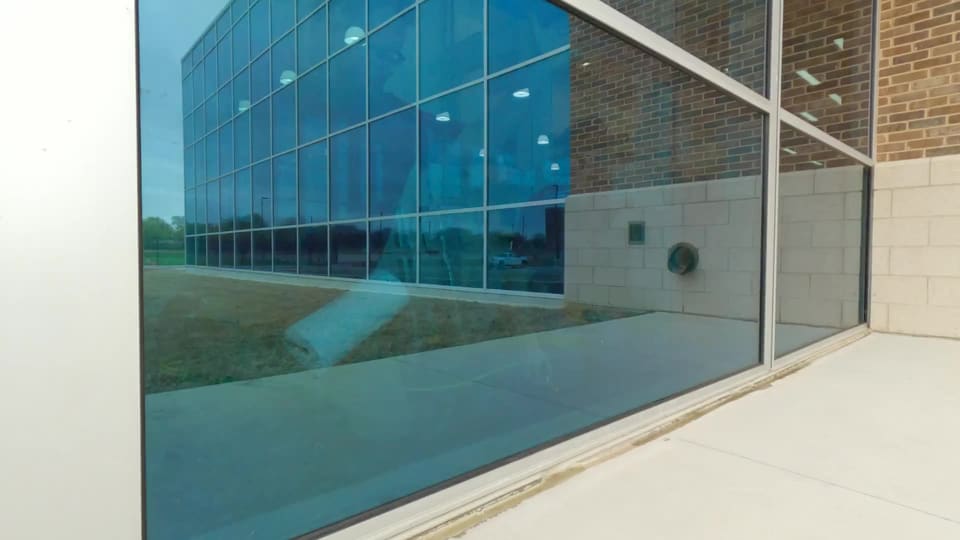
Bird deterrent window film
Keep the view. Lose the strikes.
More than a billion birds a year die against glass in the U.S., most of them on ordinary low-rise buildings that reflect trees and sky. Bird-safe film and markers applied to the exterior surface in a 2-inch pattern make the glass visible to birds and nearly invisible to people — and Epic can put solar control on the same lite in the same visit.
- Exterior-surface 2" × 2" patterns
- Authorized Feather Friendly® dealer · 3M Fasara
- LEED pilot credit 55 · ordinance compliance
- Mockup on your glass first
Birds don’t see glass. They see what it mirrors.
A bird flying toward a window is flying toward the trees and sky reflected in it. The fix is not tint and not a decal in the corner — it is a pattern on the outside surface, dense enough that there is no two-inch gap to aim for, light enough that occupants stop noticing it within a day.
- Applied to surface 1 (exterior) — the only surface birds can see in daylight
- 2" × 2" spacing per American Bird Conservancy guidance
- Highest-risk glass first: corners, skywalks, glass railings, lobbies facing landscape, the first four floors
- Documented for LEED SSpc55 and bird-friendly building ordinances
- Installed by Epic’s own certified crews — exterior work, lifts and all
Four ways to make glass bird-safe.
Feather Friendly® markers — Epic is an authorized dealer
Small, evenly spaced exterior markers in a 2" × 2" grid — the pattern recognized by the American Bird Conservancy. The markers cover roughly 6–8% of the glass, so more than 90% of the view stays open to people inside; birds read the glass as a surface. 15-year warranty; 15-plus-year service life. The most-specified bird-safe treatment in North America and the one most ordinances reference. Epic is an authorized Feather Friendly dealer and installer.
3M™ Fasara™ patterned films
Where the architect wants the treatment to read as design — frosted dots, lines or gradients applied to the exterior surface in bird-safe spacing. Doubles as privacy or glare control on the same lite.
Full-coverage bird-safety films
Continuous printed or textured films (dot, stripe and UV-reflective patterns) for curtainwall, skywalks, glass railings and corners where two glass walls meet — the highest-risk geometry on any building.
Paired with solar control
Most bird-strike glass is also heat-gain glass: large, reflective, facing landscape. Epic installs bird-safe markers on surface 1 and 3M solar film on surface 4 in one mobilization — one scope, one crew, two problems solved.
Architects, campuses, and anyone with a glass corner near trees.
Bird-friendly design has moved from a sustainability talking point to a line in the spec. It shows up in LEED submittals, in municipal ordinances, in university and healthcare design standards, and in the complaint from the facilities director who is tired of the morning walk-around.
- New construction and major alterations under bird-friendly ordinances
- LEED projects pursuing pilot credit 55
- Universities, hospitals, corporate campuses with landscaped glass
- Skywalks, glass guardrails, atria and lobby corners
- Any building already planning solar film — do both in one scope
Which US cities and states require bird-friendly glass?
A growing list. Most rules cover new construction and major alterations, not glass already in place; in New York City and Washington, DC, replacing all or most of a building’s exterior glazing also triggers the rule. These are the rules buyers ask us about most. Codes change, so confirm the current text with your jurisdiction. Epic documents threat factor, coverage and surface placement for your submittal.
| Where | The rule | What it covers | Source |
|---|---|---|---|
| New York City | Local Law 15 of 2020 (NYC Building Code §1403.8). In effect since January 2021. | Bird-friendly materials, threat factor 25 or less, on the exterior wall up to 75 feet, plus glass railings, awnings and other bird hazards at any height. Alterations that replace all exterior glazing must comply. | NYC Local Law 15 of 2020 (PDF) |
| Washington, DC | Migratory Local Wildlife Protection Act of 2022 (D.C. Law 24-337). Applies to building permits issued after October 1, 2024. | Bird-friendly materials, threat factor 30 or less, up to 100 feet on new commercial, institutional, District-owned and 5-plus-unit residential buildings, and on alterations that replace 75% or more of the exterior glazing. | D.C. Law 24-337 (DC Council) |
| Madison, Wisconsin | Zoning Code §28.129, Bird-Safe Glass Requirements. In effect since October 1, 2020; upheld by a Wisconsin appeals court in 2023. | Buildings over 10,000 sq ft, including expansions. In the first 60 feet: where glass is half the facade or more, treat 85% of it; where it is less, treat 85% of glass areas 50 sq ft and larger. Glass within 15 feet of a building corner is also covered, and every glass railing must be treated. Skyways and at-grade glass features on any size building. Dot patterns no more than 2" × 2" apart. | Ordinance text (ABC copy, PDF) |
| Maryland (state-funded buildings) | Maryland Sustainable Buildings Act of 2023 (Chapter 581, HB 6). In effect since October 1, 2023. | State buildings built, substantially altered or acquired with more than 50% state funds must meet state standards consistent with LEED’s bird-collision credit and American Bird Conservancy recommendations, to the extent practicable and within budgetary constraints. Public school construction projects and public work contracts under $500,000 are exempt. | Chapter 581 of 2023 (PDF) |
| San Francisco | Planning Code §139, Standards for Bird-Safe Buildings (Ordinance 199-11). In effect since November 2011. | New construction, replacement facades and bird-hazard features anywhere in the city. Location rules for buildings near large open space or water, and within 300 feet of an Urban Bird Refuge. | SF Planning code summary (PDF) |
| Palo Alto, California | Municipal Code §18.40.280 (Ordinance 5695). In effect since May 7, 2026. | New construction, major remodels, new glazing on existing buildings, bird-hazard installations and glass within 15 feet of a green roof. Applies to unbroken glazing of 24 sq ft or more. | City of Palo Alto |
| Berkeley, California | Municipal Code §23.304.150 (Ordinance 7864-N.S.). In effect since July 27, 2023. | New construction, additions and new or replacement glass in the first 75 feet (residential and mixed-use only at 10,000 sq ft and over 35 feet average height), plus glass railings, balconies and other high-risk features at any height. One compliance path: threat factor 30 or less. Existing windows are exempt. | City of Berkeley checklist (PDF) |
| Chicago | No citywide ordinance yet. A bird-friendly design ordinance is pending in City Council; it moved to the Zoning Committee in July 2026. | As proposed: new construction and extensive renovations, with exemptions such as homes of three units or fewer. Today the city’s Sustainable Development Policy gives weight to bird-friendly design on the projects it covers. | WTTW News, July 2026 |
Summaries for planning, not legal advice. Checked in October 2026 against the linked sources.
Bird deterrent film questions
How many birds are we actually talking about?
Why does the film go on the outside of the glass?
What is the “2 × 2 rule”?
Will it block the view or look like a sticker job?
Does it count toward LEED or a code requirement?
What is bird-friendly glass?
Do bird-friendly glass laws apply to existing buildings?
Has Epic installed bird-deterrent film before?
Request a bird-safe glass assessment
Tell us the building and the elevations that take the hits. We’ll survey the glass, flag the high-risk geometry, recommend a pattern, and bring a mockup to the site before anything is ordered.
Four ways in. Pick the one that fits today.
Request a free assessment
On-site survey, film recommendation, written estimate. No obligation.
Request a free energy audit
Every 3M film ranked on your building’s glass, rate and climate — then verified with data loggers.
Download a spec card or guide
Fifteen Epic spec cards, the Epic Method sheet, and the buyer’s guide — free.
Talk to a Solutions Advisor
866.EPIC.117 · Monday–Friday 8–5 Central. A person, not a phone tree.
 Cookies on epiccos.com
Follow the work
Real installs, real tests, real schools. Pick the feed you actually open — same crew, same standard everywhere.