
The way out: before you buy bullet-resisting glass
Bullet-resisting glass is a wall in a tornado, a fire or with an intruder inside, and no answer to a blast. What attached film does, and how to scope it.
6 min read · Updated October 23, 2026
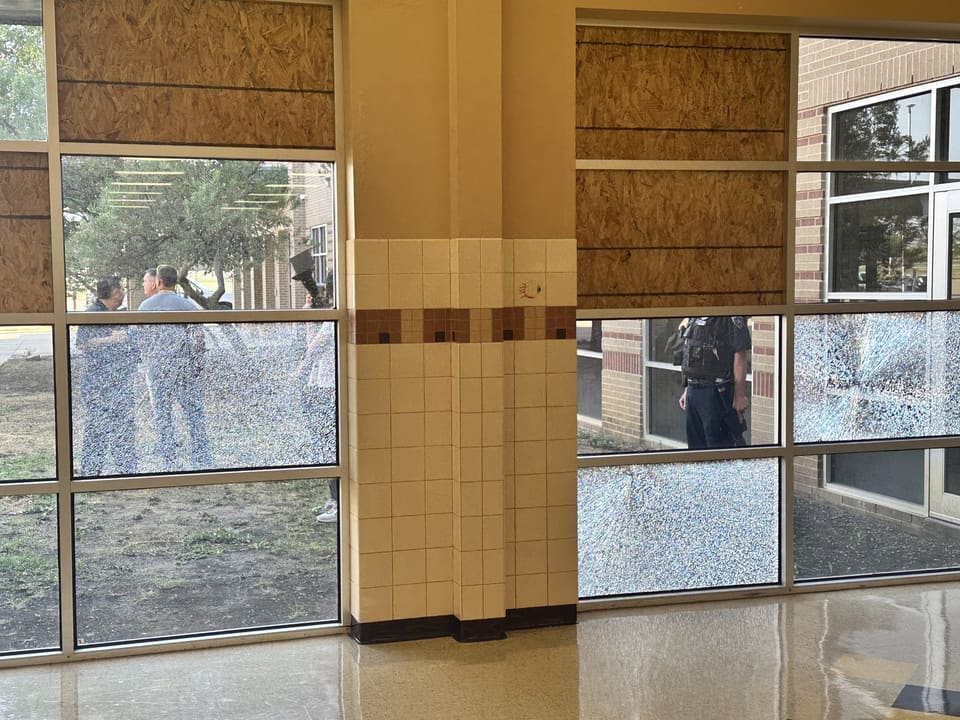
Picture a classroom on a spring afternoon in Tornado Alley. The sirens have gone, the students are in the hallway position, and the storm takes part of the roof. The corridor is blocked. Or a fire starts between the room and the exit. Or a structural shift jams the door. Or the situation nobody wants to picture: an intruder is already inside the building, and the window is the only way away from the threat.
In every one of those cases the people in the room need to get out through the glass, and the first responders outside need a way in. That is the question a district should ask before it buys any product that promises to stop a threat at the window: when the emergency is on this side of the glass, can we still leave?
What is being bought, and why
When a district is offered bullet-resisting glazing, the UL 752 product class, for every classroom window, the reasoning is easy to follow. The threat everyone is thinking about is an active shooter; the product is built to stop bullets; a standard with “active shooter” in its title, ASTM F3561, has started to appear in RFPs. The heaviest product on the shelf feels like the responsible choice.
It is a different product class with its own frames and budgets, and a trade-off that rarely makes the board presentation. Glazing built to stop bullets does not stop being a wall when the emergency changes. A campus that puts it in every classroom has traded away the window as a second way out of every classroom. In Tornado Alley and across the Plains that is not a theoretical trade; buildings lose roofs and walls every spring, and a shelter-in-place plan with no exit is half a plan.
No window film is bulletproof, and Epic will never describe one that way. That is the honest half of the comparison. The other half is what attached security film is actually for.
What attached security film does
Security film anchored to the frame with a structural attachment keeps the broken glass in the opening. When the glass is struck, the pane shatters, the film holds the fragments together, and the attachment holds the whole filmed pane to the frame so a hole is not made on the first blows. It is designed to stop intruders by delaying entry: the intruder is still outside, still visible, still making noise, which is what lockdown procedures are built around. The film Epic specifies for entries and vestibules is 3M S2400, a 24-mil polyurethane film, attached with 3M Impact Protection Attachment installed the Epic way.
The proof is on record. In September 2023 a windstorm lifted rock ballast off a Godley ISD roof and threw it through the glass below; the entry and lower windows Epic had filmed shattered and stayed in their frames, and the unfilmed windows blew out. With the glass already broken, the district’s own police officers attempted a forced entry through the filmed openings, and the district’s letter says it plainly: “we observed a significant delay in forced entry.” One of Colorado’s largest school districts ran its own impact and attachment field evaluation of competing products before awarding Epic the largest project in 3M’s history. Those letters are on the references page.
And the part that answers the question at the top of this piece: security film resists entry from the outside. It does not seal people in. From the inside, occupants and first responders can get through filmed glass with the right technique. Epic educates its customers on this, and will walk a district’s safety team and first responders through it on their own glass. We do not publish the technique, for the same reason we do not publish breach times. The protection and the exit can be the same opening, and a district choosing between film and a rated system should be told that before it signs.
The threat nobody is scoping: a blast
Epic’s founders bring nearly three decades in security glazing, and Chris Eder started on the blast side of this industry. Before Epic, at a prior company, he put blast-mitigation film and attachment systems on federal buildings in Washington, D.C., and on U.S. embassies and ambassadors’ residences on three continents, and an electronic-eavesdropping-blocking film with blast-mitigation capabilities on the White House, installed without an attachment system. In the late 1990s he was installing security film with an attachment system of his own invention, the predecessor of the Epic Method, on schools in Germany against backpack bombs. The lesson of that work is about glass. FEMA’s guidance on explosive blast says high-velocity glass fragments “have been shown to be a major contributor to injuries.” In the Oklahoma City bombing, glass was the most frequently reported cause of injury, 38 percent of injuries by the state health department’s count. Nobody had scoped the glass on the upper floors, or in the buildings across the street.
Chris Eder’s view, from that history, is that school security planning will eventually have to account for an explosive device, and that when it does, the windows left off every plan, the second floor, the gym, the glass nobody considered a target, become the hazard.
That is also where bullet-resisting glazing gives the least comfort. A UL 752 rating is a ballistic rating, not a blast rating; blast performance is rated separately, under ASTM F1642 and GSA TS01-2003, by where the glass fragments land. The ballistic standard itself tests for spall, fragments thrown off the protected side, and a lite without a containment layer on the inside face does not earn its no-spall rating. Heavy glazing in a frame never designed for blast load can shed fragments from its inner face or leave the frame like any other glass. Fragment-retention film on the inside face, attached to the frame, is the retrofit answer to that hazard class: rated by where the fragments land, the retrofit that went onto federal buildings after Oklahoma City in work Chris Eder was part of at a prior company, and as suited to a second-floor window as to a vestibule. 3M applies its published blast results to commercial and non-educational government facilities, and Epic does not quote them for a school; the point here is the hazard class, not a rating.
How to scope a campus
Walk the building the way an intruder or a storm would meet it. The glass an intruder reaches first, entries, vestibules, sidelites and the ground-floor windows beside doors, gets the thickest film 3M makes, attached to the frame. Interior door lites, corridor glass and upper floors usually need safety glazing and glass retention, not forced-entry delay. Exposed elevations in storm country may call for windstorm-tested film. A rated glazing system belongs where a threat assessment puts it, a transaction window or a specific entry, not across a campus, and the fire marshal and the district’s safety team should see the plan before any window stops being a way out. If the district’s risk assessment includes an explosive device, the scope widens: fragment-retention film belongs on the glass nobody considered a target, upper floors included.
Buying the heaviest product for every opening spends the budget that should have covered the entry, and often leaves the vestibule with the same protection as a third-floor classroom. The opposite mistake is just as common: film with no attachment to the frame, which is not a forced-entry product at all.
Epic’s free survey walks every opening with your safety team, documents the glazing, and returns a written scope opening by opening, with the product named for each and the reason, including which openings, if any, need something other than film. Districts buy through TIPS and Equalis nationwide and BuyBoard in Texas, with grant documentation support, and the conversation about getting out comes with the scope. The longer version, with the standards to ask for and where buildings over- and under-secure, is How to protect glass for safety.
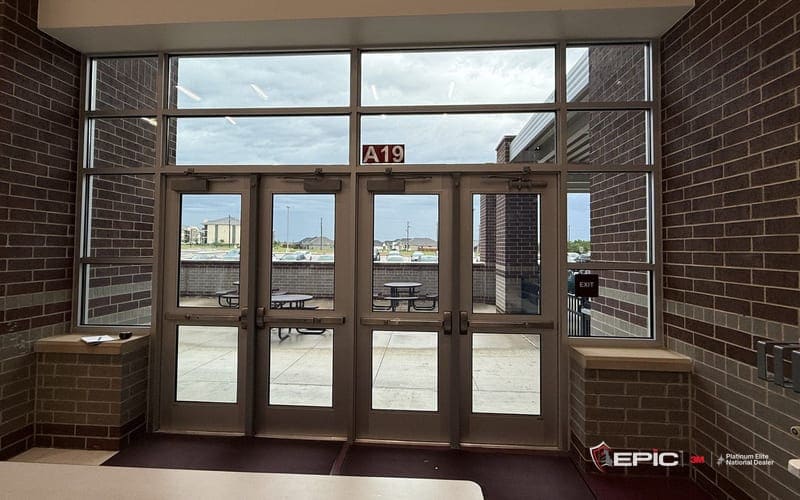
See 3M security film on school doors before it goes on.
Not sure what a visualizer is? It’s a picture of sample school entry doors. Pick a 3M safety and security film, drag the handle to compare the glass with and without it, and read 3M’s published light and heat numbers beside the picture. Or upload a photo of your own doors; it stays on your device.
- 1Pick a room
- 2Pick a 3M film
- 3Drag to compare
Ready for a firm number on your glass?
A free on-site assessment. Measurements, film recommendation, and a written estimate — no pressure, no obligation.
 Cookies on epiccos.com
Follow the work
Real installs, real tests, real schools. Pick the feed you actually open — same crew, same standard everywhere.